
Rethinking the Post-Easing Era | Mingde Forum 2017 Successfully Held
Nov 13, 2017 · 0 views
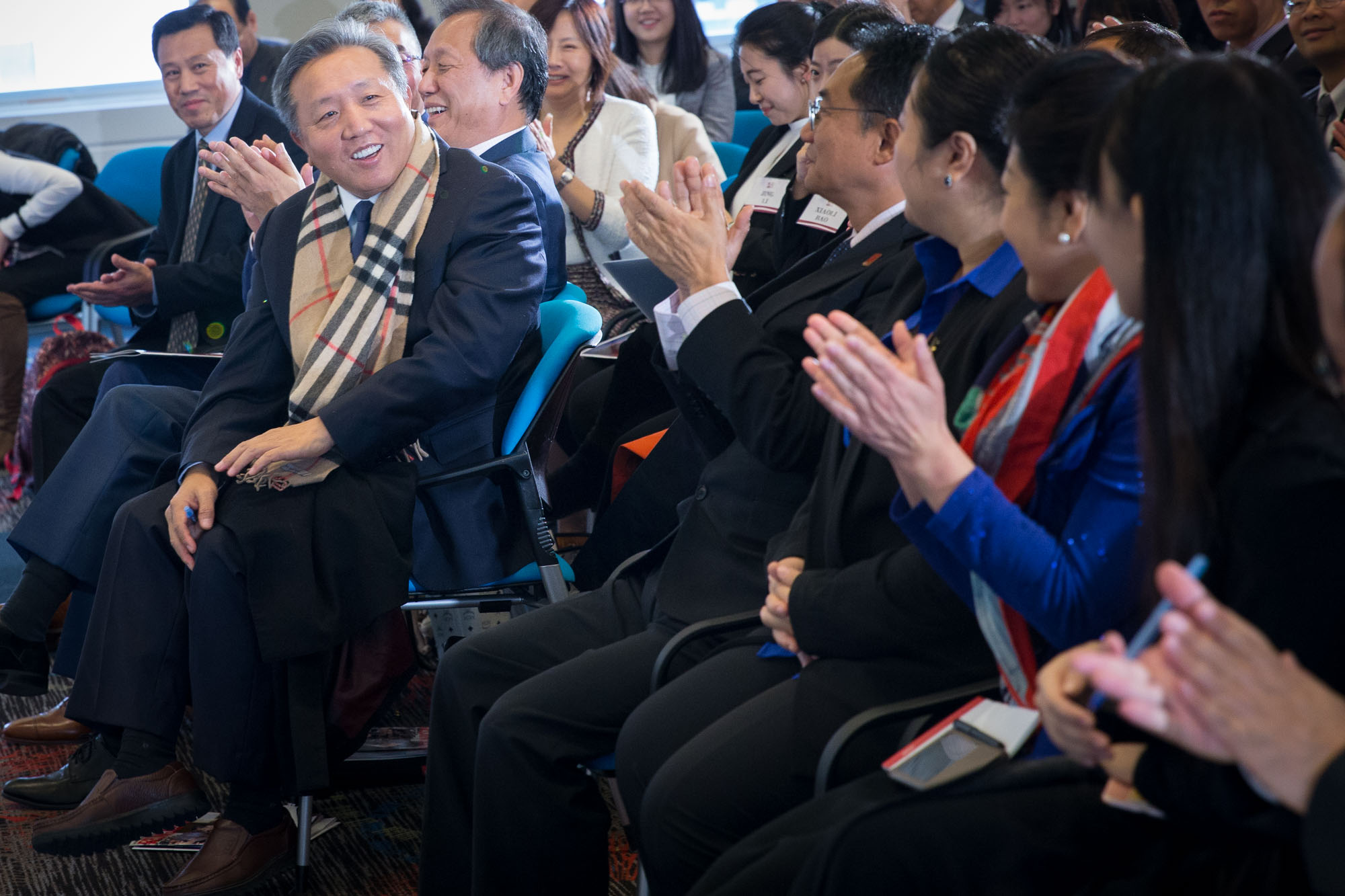
Mingde Forum 2017, jointly hosted by the RUC North America Alumni Association and other organizations, was held on November 12 at Rockefeller Center, one of New York City’s iconic landmarks, as part of the celebration of Renmin University of China’s 80th anniversary. Professor Wu Xiaoqiu, Vice President of Renmin University of China and a renowned economist, traveled specially to New York to attend the event. Zhang Meifang, Deputy Consul General of the Chinese Consulate General in New York, also attended and delivered remarks.
More than 200 senior professionals from the economic, financial, business, education, and cultural communities in China and the United States, together with RUC alumni from more than a dozen U.S. states, gathered to discuss macroeconomic policies, investment strategies, and cultural exchange in the new era.
Mingde Forum is an open, inclusive, international, and academically oriented forum platform initiated by the RUC North America Alumni Association in 2016. This year marked the second annual meeting. Jointly hosted by the RUC North America Alumni Association, Deloitte, Beijing Review, China.org.cn, and Benimax Investment, the forum was held under the theme “Policy and Investment in the Post-Easing Era.”
More than 20 distinguished speakers, including prominent RUC alumni, took the stage to discuss investment strategies in a changing market and evolving policy environment, examine the history and current state of China-U.S. relations, and explore ways to promote exchanges between China and the United States in areas including economics, education, and culture.
As 2017 marked the 80th anniversary of Renmin University of China, this year’s annual meeting also featured a special anniversary segment, providing an opportunity to look back on memories of the alma mater and celebrate the bonds among alumni.
The conference opened with a special video presentation celebrating the 80th anniversary of Renmin University of China.
Professor Wu Xiaoqiu delivered the opening remarks, extending warm greetings and best wishes from the alma mater to RUC alumni in North America. He said that the RUC North America Alumni Association was one of the most outstanding alumni organizations overseas, and that Mingde Forum was also a particularly important part of the university’s 80th-anniversary celebrations and had received the university’s close attention.
He noted that General Secretary Xi Jinping had sent a congratulatory letter to Renmin University of China on the occasion of its anniversary, which greatly encouraged faculty, students, and alumni. He also highlighted the university’s strong standing among China’s “Double First-Class” universities, with 14 disciplines recognized as first-level disciplines, describing this as a source of great pride.
Professor Wu said that the second Mingde Forum was being held at an particularly opportune moment, shortly after the successful conclusion of the 19th National Congress of the Communist Party of China. He noted that the congress had laid out a clear vision for China’s future development and announced that China had entered a new era. A series of important changes were expected in the years ahead, reflecting China’s role as a major country and its growing influence in the world, while marking China’s increasing movement toward the center of the global stage.
Against this backdrop, he said, it was particularly meaningful for RUC alumni in New York to convene the Mingde Forum and discuss a series of major issues and ideas.
Zhang Meifang, Deputy Consul General of the Chinese Consulate General in New York, said in her remarks that “the way of the Great Learning lies in manifesting luminous virtue,” noting that Renmin University of China is internationally renowned for disciplines including economics, finance, and journalism.
On behalf of the Consulate General, she extended warm congratulations on the Mingde Forum being held at this important historical moment and expressed the hope that the forum would continue to broaden the scope of its discussions and make full use of the important role of people-to-people diplomacy.
Deputy Consul General Zhang also introduced the major outcomes of the 19th National Congress and discussed the significance of President Donald Trump’s visit to China for China-U.S. relations and the world. She encouraged RUC alumni to better understand the new developments and changes taking place in China in the new era, return to China more often to see and experience its development firsthand, contribute to the country’s modernization, and actively participate in China-U.S. exchanges based on cooperation and mutual benefit.
Yue Jingsheng, Chairman of the RUC North America Alumni Association; Ma Yunxia, Managing Director of Tax at Deloitte; Yang Li, Senior Manager of Deloitte China Services Group; Ding Ying, Deputy Head of the North American Bureau of Beijing Review; and Dawson Lee, President of Benimax Investment, also delivered remarks, extending their congratulations on Renmin University of China’s 80th anniversary and best wishes for the success of the forum.
They warmly welcomed the guests and alumni in attendance and expressed their sincere appreciation for the professionalism and unity demonstrated by the RUC North America Alumni Association.
The forum sessions were moderated by Wu Yafeng, President of the RUC North America Alumni Association. In his opening address, he said that the recently concluded 19th National Congress had made a new assessment of China’s historical position in its development, signaling new characteristics in China’s future reform and development. These changes, he said, were worthy of discussion and consideration by all Chinese people.
At the same time, the world was undergoing profound changes that would have far-reaching effects on economies, markets, business operations, and individual careers.
He said the forum was designed to examine the major issues of the new era from a practical perspective, using a combination of theory and real-world analysis to understand the principal challenges of the times, while remaining committed to seeking truth from facts and to “investigating things and extending knowledge.”
Jiao Chengyue, President of the New York Branch of China Merchants Bank, delivered a keynote presentation. He said the global economy was characterized by slow growth, a moderate recovery, and continued divergence. At the same time, China’s banking sector faced a range of challenges, including fewer opportunities in bond investment portfolios, tighter macroprudential policies, increasing pressure on bank capital, enhanced risk inspections and business rectification, changes in government financing models, and the transmission of cross-sector financial risks.
Using China Merchants Bank as an example, he introduced the strategies adopted by China’s banking sector in response to these challenges, generating considerable resonance among the participants.
Panel 1 | The Macroeconomic Landscape
Under the moderation of Guan Ning, Chief Investment Officer of QuantScape, Professor Wu Xiaoqiu; Li Shanquan, Senior Vice President of OppenheimerFunds; Hu Jian, Managing Director at Moody’s Investors Service; Geng Yi, Senior Economist in the Office of the Chief Financial Officer of the Government of Washington, D.C.; Tang Qi, Senior Vice President at Neuberger Berman; and Luo Yin, Vice Chairman of Wolfe Research LLC, engaged in an in-depth discussion of policies in the “post-easing era.”
Guan Ning noted that data from different countries showed that economic growth had brought down unemployment rates, while inflation remained well below central-bank targets. The issue of asset bubbles had therefore become an important topic of discussion.
Li Shanquan said he did not personally believe that the strength of the U.S. market was sustainable. U.S. debt was equivalent to roughly one year of GDP, and addressing the debt burden would require higher labor productivity, substantial budget cuts, or an improvement in the international balance of payments. In his view, all of these options were difficult to achieve in practice, leaving a significant depreciation of the U.S. dollar as the only potentially viable approach.
Hu Jian, by contrast, argued that the U.S. economy remained relatively stable and healthy. Driven by technological development, prudent monetary policy, and fiscal stimulus, he said, the current U.S. economic expansion could potentially become the longest on record.
Tang Qi analyzed the causes of the current global inflation environment from the perspectives of information technology, demographic structure, and economic cycles.
Geng Yi examined the potential economic benefits and drawbacks of the U.S. tax-cut plan from the perspective of his professional experience.
Drawing on his own industry experience, Luo Yin analyzed development trends in the asset management sector.
Professor Wu Xiaoqiu delivered a special presentation during the panel discussion. He said China’s financial sector would undergo major market-oriented changes over the next five years, including structural adjustments, particularly in the composition of financial assets; changes in consumption patterns driven by technology; and greater internationalization that could help China become a global financial center.
He focused in particular on the internationalization of China’s financial sector and offered his outlook for the development of renminbi-denominated assets. He emphasized that only through financial development and financial globalization could China’s financial sector align with the country’s status as a major global power.
He also said there was neither sufficient basis for a major appreciation of the renminbi nor a foundation for a sharp depreciation, and that the currency would likely fluctuate within a relatively stable and moderate range in the future.
In conclusion, he stated that the future of China’s financial sector was promising.
Panel 2 | Cross-Border Investment
Professor Peng Liang of the Smeal College of Business at Penn State University moderated the “Cross-Border Investment” panel. Lin Ning, Managing Director of Fosun Group; Zhang Hua, Chairman of Dingxin Great Wall Fund; Shi Shuisheng, Managing Director of The Oakleaf Group; Dawson Lee, President of Benimax Investment; and Liu Xiaona, General Manager of Baiyuan JIYE Real Estate Development Co., Ltd., engaged in an in-depth discussion of investment strategies under the new landscape.
Peng Liang analyzed the regional characteristics and heterogeneity of the real estate market, noting that returns in private real estate markets and the real estate investment trust market were highly predictable.
Lin Ning examined the challenges facing Chinese companies in overseas mergers and acquisitions. He noted that cultural differences were only part of the challenge: some companies were unfamiliar with procedural details, which could affect the negotiation process. Against the backdrop of adjustments in national policy and reduced encouragement for cross-border acquisitions, he emphasized the importance of focusing on high-quality acquisitions.
Zhang Hua and Shi Shuisheng analyzed investment and securitization in the real estate sector from the perspectives of the Chinese and U.S. markets, respectively, as well as lessons from the development of asset securitization following the global financial crisis.
Dawson Lee connected real estate investment with the political landscape of the two major U.S. parties, analyzing the relative investment opportunities and challenges in red states and blue states.
Liu Xiaona analyzed real estate investment opportunities in China’s third- and fourth-tier cities.
Panel 3 | China-U.S. Exchange
“China-U.S. Exchange” was a specially created topic for this year’s forum, highlighting the strong humanistic and social-science tradition of Renmin University of China.
Moderated by Professor Wei Detong, the Chinese Director of the Confucius Institute at Columbia University, the panel featured Ding Ying, Deputy Head of the North American Bureau of Beijing Review; Professor Li Chunyan of Pace University; Professor Liu Lening of the Department of East Asian Languages and Cultures at Columbia University; Professor Sun Zhe, Co-Director of Columbia University’s China Program; and Xin Xin, Founder of BGC Media.
Together, they examined the history and current state of China-U.S. relations and discussed ways to promote exchanges in economics, education, culture, and other fields.
Ding Ying analyzed how people in China and the United States perceive one another and emphasized the important responsibility of the media in shaping public understanding.
Li Chunyan, who has spent many years advocating for the rights and interests of Asian Americans and Chinese Americans, pointed to the stereotypical biases that continue to exist to some extent in American society.
Liu Lening, who also serves as the U.S. Director of the Confucius Institute at Columbia University, offered candid criticism and constructive suggestions concerning Chinese-language education and cultural communication.
Sun Zhe compared Chinese and U.S. think tanks, pointing out shortcomings in China’s domestic think-tank system while expressing firm confidence in China’s economic development.
Xin Xin shared examples from his own media entrepreneurship, explaining how he had created opportunities for cross-cultural exchange through his work in the media industry.
Following the forum, Professor Wu Xiaoqiu told senior representatives of the RUC North America Alumni Association that the event had given him “three surprises.”
First, he said, he had not expected the forum to be of such a high standard. Even in China, he noted, the forum would qualify as a top-level professional event.
Second, he had not expected the moderators to be so impressive. In his view, they were fully comparable to professional television hosts on China Central Television and demonstrated a high level of professionalism.
Third, he had not expected so many people to attend. A gathering of more than 200 participants, he said, would not be easy to organize even in China.
Professor Wu once again expressed his strong recognition of the achievements of the RUC North America Alumni Association and thanked the alumni for enhancing the university’s influence and reputation overseas.
The forum received enthusiastic support from RUC alumni across North America. Alumni from the greater New York area participated actively, while many others traveled to New York specifically for the event from San Francisco, Los Angeles, Houston, Ann Arbor, Atlanta, Washington, D.C., and other cities. Several alumni even flew in from China to attend the forum and witness the strong presence of RUC alumni on the international stage.
Dozens of young alumni volunteered to support the event, helping ensure its successful execution and demonstrating both the spirit of service among RUC alumni and the strong sense of community within the RUC North America Alumni Association.
Also attending the forum were Guo Haiying, Director of the Alumni Office at Renmin University of China; Chen Chenchen, Research Fellow at the Chongyang Institute for Financial Studies, Renmin University of China; Wang Yuting, Executive Vice Chairman of the RUC North America Alumni Association; Liu Jing, Executive Vice President; and Vice Presidents Xie Ren and Ma Teng.
More than 30 guests were invited, including representatives of Chinese companies in the United States, representatives of the Chinese community in the New York area, senior leaders of the Alliance of North American Alumni Associations of Chinese Universities, and representatives of the North American alumni associations of leading Chinese universities, including Peking University, Tsinghua University, Zhejiang University, and Fudan University.
Nearly 20 major media organizations, including Xinhua News Agency, People’s Daily, China Central Television, China News Service, China Daily, Economic Daily, World Journal, Qiao Bao, Ta Kung Pao, Wen Hui Bao, Phoenix Finance, Bloomberg, and Chinese Business News, covered the event.
Acknowledgments
The successful organization of Mingde Forum 2017 would not have been possible without the selfless dedication of more than 30 volunteers. The RUC North America Alumni Association extends its sincere appreciation to all of them.
Alumni Volunteers:
Guo Zhaoyi, Huang Xiaoya, Jiang Di, Lai Yun, Li Jiawei, Liang Xueying, Lin Yi, Liu Qinghua, Lu Kun, Luo Kan, Ouyang Zhe, Pan Qichang, Peng Xiaoshan, Song Chenyang, Xie Wenjia, Yang Yaxu, Zhang Cheng, Zhang Jingrui, Zhang Lu, Zhang Zeyu, Zhao Boyang, Zou Diya, Gao Wei, Lin Ping, Sun Yuehan
Deloitte Volunteers:
Cheng Sixin, Ge Ying, Guo Yilin, Huo Sijie, Jin Nan, Ju Shahe, Mo Chenming, Sui Xiaoxu, Tang Qian, Xing Te, Yu Yang, Zhang Lu