
Seeking Certainty Amid the Unknown | Mingde Forum 2019 Successfully Held
Nov 12, 2019 · 0 views
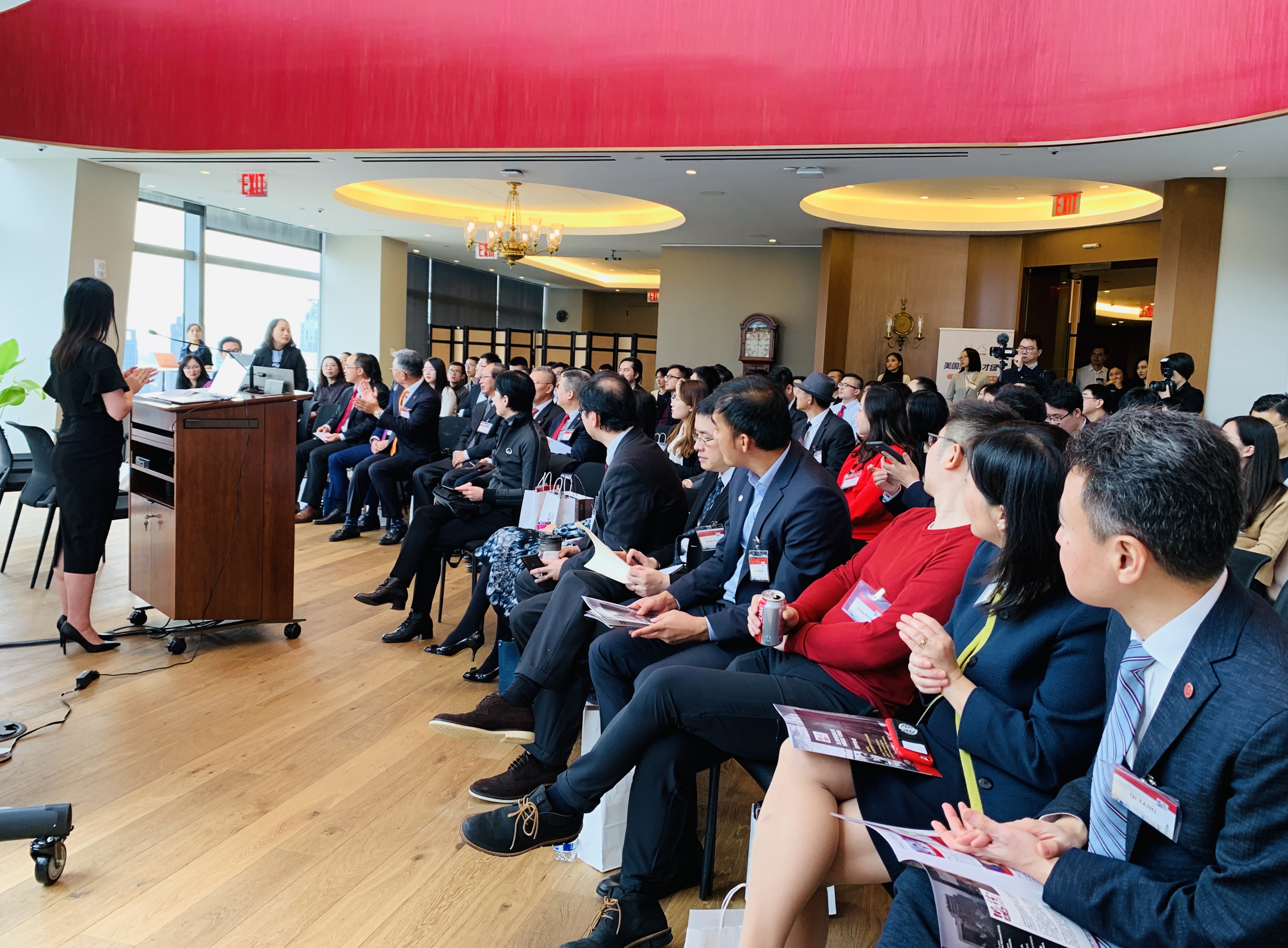
As autumn colors spread across the mountains and alumni returned from near and far, New York once again welcomed old friends. On November 10, Mingde Forum 2019, hosted by the RUC North America Alumni Association, was held at the Bank of China New York Branch building in Times Square. Professor He Yaomin, Vice President of Renmin University of China, led a delegation to attend the event and delivered remarks.
More than 100 alumni and guests attended, including key members of the RUC North America Alumni Association, representatives of the Consulate General of China in New York, representatives of partner organizations, representatives of Chinese enterprises operating in the United States, and RUC alumni from nearly ten U.S. states.
Founded by the RUC North America Alumni Association in 2015, Mingde Forum is an open and international platform that seeks to balance academic inquiry with practical perspectives. This year marked its fifth consecutive annual meeting in New York. The forum had become one of the highest-level professional forums organized by RUC alumni overseas, with considerable visibility and influence among Chinese communities in North America.
The theme of Mingde Forum 2019 was “New Territories: How to Navigate in Uncharted Waters.” The program featured two major topics: “Global Macroeconomic Outlook and Investment Decision-Making” and “The Potential and Applications of Blockchain Technology and Cryptocurrencies.” More than a dozen experienced professionals from the fields of finance, academia, entrepreneurship, and technology were invited to engage in in-depth discussions.
Remarks by Vice President He Yaomin
Representing Renmin University of China, Vice President He Yaomin extended his warm congratulations on the opening of the forum and expressed his sincere appreciation for the RUC North America Alumni Association’s longstanding commitment to serving alumni, promoting the image of the university, and upholding a practical, fact-based approach.
In his remarks, Vice President He introduced the university’s development in recent years, with particular emphasis on the construction of its new campus in Tongzhou. He expressed his confidence that, with the support and care of the central government, the new campus would become one of the most beautiful university campuses in China and a home of which alumni could be proud.
He said China was moving rapidly forward with reform and opening up. From the central government to local authorities, there was a broad vision, a larger perspective, and ambitious plans for development. He expressed his belief that China would undergo significant changes, that its rise was inevitable, and that misunderstandings of China in the United States would gradually diminish.
He encouraged RUC alumni to study diligently, work hard, and remain attentive to China’s development and progress.
Remarks by Yue Jingsheng
Yue Jingsheng, Chairman of the RUC North America Alumni Association, extended a warm welcome on behalf of the association and the Mingde Forum organizing team to the university leaders, distinguished guests, and alumni attending the forum.
He expressed sincere gratitude to the university for its continued care and support, to people from various sectors for their assistance, and to alumni for their participation and contributions.
Yue said that after several years of development, the RUC North America Alumni Association had remained committed to bringing alumni together, supporting their professional development, and promoting the image of Renmin University. The association had earned recognition from various quarters, and, most importantly, the trust of its alumni.
He expressed the hope that the association would continue to strengthen both horizontal and vertical connections and further fulfill its role as a bridge and platform for alumni.
Remarks by the Consulate General of China in New York
Xing Jijun, Science and Technology Counselor at the Consulate General of China in New York, congratulated the organizers on the successful opening of Mingde Forum.
He said that Renmin University of China was not only an elite university in China but also a distinctive institution globally. What was particularly noteworthy, he said, was the RUC North America Alumni Association’s ability to bring alumni together through various initiatives. Its activity and vitality were both impressive and rare.
Although the theme of the forum was how to navigate in an uncertain environment, Xing noted that there were several things that could be regarded as certain: China would continue to pursue high-quality development, Renmin University would continue to move forward, and the strength of RUC alumni would continue to grow.
He also recalled his own experience studying at Renmin University and expressed deep gratitude for the education he had received there. The influence and personal transformation brought about by his alma mater, he said, would benefit him throughout his life. He expressed his hope that after returning to China following his assignment in New York, he would be able to contribute to Renmin University in whatever ways he could.
Remarks by Partner Organizations
The forum received strong support from the Bank of China New York Branch. Peng Jinjun, Executive Vice President of the branch, who was in China on official business at the time, sent a congratulatory letter expressing his best wishes for the successful event.
As an RUC alumnus, Peng said he was deeply encouraged by the RUC North America Alumni Association and Mingde Forum’s commitment to the country and the wider world, their adherence to the university motto of “Seeking Truth from Facts,” and their efforts to carry forward the spirit of Mingde.
He noted that the world was going through a historical period filled with both challenges and opportunities, requiring politicians, economists, and investors to apply their wisdom. He looked forward to the forum’s speakers and participants exchanging ideas through presentations and discussions and bringing broader and richer perspectives to the audience.
Li Deshun, Council Member of the RUC North America Alumni Association and President of Benimax Investment, and Yu Shujun, President of the North American Bureau of Beijing Review, also delivered remarks on behalf of the forum’s partners.
Li Deshun said that from national liberation to the founding of New China, and from national development to reform and opening up, Renmin University had consistently stood at the forefront of the times during periods of historical transformation. RUC alumni, he said, had always been among those with the strongest sense of responsibility and ambition.
He noted that both the RUC North America Alumni Association and Mingde Forum were pioneering initiatives. Benimax was honored to have participated in the forum for many years and to have grown together with its partners through their collaboration.
Yu Shujun said that as both a representative of a partner organization and an RUC alumna, she felt a dual sense of pride. She praised Mingde Forum for creating an open platform for dialogue and promoting exchanges between China and the United States. She noted that this was closely aligned with Beijing Review’s mission of “letting the world hear more voices from China” and represented a valuable effort to explore more effective channels of communication in a changing media environment.
Panel 1 | Global Macroeconomic Outlook and Investment Decision-Making
Discussion of the global macroeconomic outlook and investment decision-making has long been a traditional and foundational topic of Mingde Forum, as well as one of the forum’s most closely followed segments by the media.
This year, the panel was moderated by Ning Guan, Chief Investment Officer and Founding Partner of QuantScape. Panelists included Ji Mo, Chief China Economist at AllianceBernstein; Qi Tang, Senior Vice President at Neuberger Berman; Yunsong Du, Global Head of Trading and Managing Director at SMBC; and Xiangyang Li, Managing Director at Roosevelt Management.
The panelists noted that against the backdrop of the U.S.-China trade war, Brexit, global geopolitical crises, and slowing economic growth, more than $13 trillion in bonds worldwide were trading at negative yields. At the same time, stocks, bonds, gold, and the U.S. dollar had all performed strongly during the year. While both academia and financial markets had continued to express concerns about asset bubbles and an economic downturn, recent data suggested that conditions in major economies were showing signs of improvement.
The panelists generally agreed that the probability of a global recession was relatively low. Although the U.S. Federal Reserve had cut interest rates three times that year, inflation remained around 1.7%, leaving the Fed with considerable room for monetary policy to stimulate the economy. Under these circumstances, forecasting economic conditions, policy developments, and asset prices over the following 12 months had become even more uncertain.
The panelists suggested that assessing global macroeconomic developments could begin with seven major areas:
Assessing the stage of China’s economic development;
Assessing the Federal Reserve, which fundamentally requires an assessment of the stage of the U.S. economy;
Assessing global currencies, particularly the U.S. dollar;
Assessing commodity markets;
Assessing global trade;
Assessing expectations for global inflation; and
Assessing the political environment.
They noted that assessments of commodities and global trade were, in essence, also assessments of the Chinese economy. Whether one correctly understood China’s economic position would therefore have a significant bearing on the success or failure of economic forecasts and investment decisions.
The panelists also responded to questions from younger alumni about career development. They noted that the pace of change in human society was continuously accelerating, while the cycle for skills to become outdated had rapidly shortened—from centuries and decades to increasingly shorter periods. Continuous learning had therefore become both a norm and a necessity.
They encouraged young professionals to develop genuine hard skills and continually update them. At the same time, they emphasized that learning how to conduct oneself was even more important than acquiring knowledge and methodologies: being realistic, facing oneself and others honestly, and continuously exploring one’s genuine interests.
Note: The views expressed by individual speakers represent their personal opinions only and do not constitute investment advice or represent the views of their respective institutions, the RUC North America Alumni Association, or Mingde Forum.
Panel 2 | Blockchain Technology and Cryptocurrencies
The second part of the annual meeting focused on a topic that had long attracted considerable interest among alumni: blockchain technology and cryptocurrencies.
On October 24, the Political Bureau of the CPC Central Committee emphasized the importance of making blockchain a key breakthrough in core technological innovation. Against this backdrop, the forum’s discussion of blockchain and cryptocurrencies attracted even greater attention.
The panel was moderated by Haifan Ge, Head of Americas Business at BNP Paribas GCM. Panelists included Wei Wang, Founding Partner of Puirui Capital and Chief Financial Officer of the U.S.-dollar stablecoin HonestNode; Dong Wang, inventor of the Loopring Protocol and Chairman of the Loopring Foundation; Hui Gong, Lecturer in Finance and Financial Technology at Westminster Business School in London; and Dong Yang, Vice Dean of the School of Law at Renmin University of China.
The panelists described blockchain technology as an opportunity associated with a new industrial revolution that could have a profound impact on humanity. They argued that blockchain represented a strategic technological frontier that China needed to seize, with important implications for building new infrastructure and moving toward a future digital world.
They discussed the potential for blockchain to reshape monetary systems and argued that the digitization of national currencies was inevitable. In their view, the future competitor to the U.S. dollar might not be the renminbi itself, but digital currencies, and a new form of “currency war” in the blockchain era had already begun.
The panelists also discussed blockchain’s characteristics, including the difficulty of altering information recorded on the network and its traceability capabilities. They suggested that combining artificial intelligence with blockchain technology could create new ways of governing AI systems and potentially transform human relations of production.
The speakers argued that China had the confidence and capability to surpass the United States in the blockchain field. They noted that China had been the first country to establish a research institute dedicated to digital currencies and was seeking to achieve greater technological independence through blockchain and other emerging technologies.
They emphasized that blockchain technology was still evolving and had not yet reached a mature or definitive form. In this dynamic environment, they argued, China needed to seize the technological high ground and play an active role in shaping technical standards.
The panelists also discussed the U.S. dollar as one of the three pillars of American global power and suggested that China could have significant opportunities within the evolving monetary system.
They highlighted the need for more mathematical talent, greater emphasis on translating theory into practical applications, and better regulation. They also argued that blockchain should be legalized as soon as possible, noting that legalization would require a sound theoretical basis and could then facilitate practical implementation.
Note: The views expressed by individual speakers represent their personal opinions only and do not constitute investment advice or represent the views of their respective institutions, the RUC North America Alumni Association, or Mingde Forum.
Gaoling School of Artificial Intelligence
Bin Lu, Vice Dean of the Gaoling School of Artificial Intelligence at Renmin University of China, also introduced the establishment of the school and its development goals at the forum. He expressed the hope that the school could strengthen cooperation and exchanges and promote the joint advancement of industry, academia, and research in artificial intelligence.
Closing Remarks
The forum concluded with remarks by Wu Yafeng, President of the RUC North America Alumni Association.
Wu said that after five years of sustained development, Mingde Forum had become a signature brand and an important part of the RUC North America Alumni Association’s public identity, as well as a platform of which RUC alumni could be proud.
He noted that organizing the forum had been particularly challenging amid the complex China-U.S. relationship at the time. The event had faced numerous difficulties and challenges that had been difficult to anticipate. Nevertheless, with the care and support of partners and alumni, the forum had been held as scheduled and successfully completed.
Wu expressed his gratitude to the Bank of China New York Branch for providing the venue, and to partners including Benimax, Beijing Review/China.org.cn, and My Visa Services for their sponsorship and support. He also thanked nearly 20 alumni volunteers for their selfless contributions.
Among the other guests attending the forum were Meng Fanying from the Office of Alumni Affairs at Renmin University of China; Guo Shuai from the Office of International Relations; Consul Dong Weiguo and Consul Chen Yifrom the Education Section of the Consulate General of China in New York; and key members of the RUC North America Alumni Association Council and Executive Committee, including Liu Jing, Zhao Lixin, Zou Yan, Liu Ruoke, Yang Guang, Lai Yun, and Luo Kan.
Representatives of the U.S. alumni associations of more than ten Chinese universities, including Tsinghua University, Peking University, Nanjing University, Wuhan University, Fudan University, University of Science and Technology of China, Sun Yat-sen University, Beijing Institute of Technology, and Central University of Finance and Economics, were also invited to attend.
Mingde Forum 2019 Organizing Team
Organizing Team:
Haifan Ge, Ning Guan, Lai Yun, Li Deshun, Lin Ping, Liu Jing, Luo Kan, Wu Yafeng, Yue Jingsheng, Zhang Peibei
Chief Planner:
Wu Yafeng
Executive Team:
Lai Yun, Luo Kan
Moderator:
Pan Qichang
Photography:
Yue Jingsheng, Sun Tianyue, Luo Kan
Real-Time Transcription:
Wang Rui
On-Site Team:
Cao Chenyang, Chen Han, Guan Zehua, Huang Beiqing, Huang Ruofu, Jiang Zihan, Li Jiawei, Li Zhao, Liang Tianzi, Liu Hao, Sun Xi, Zhang Chujun, Zhou Jinghui, Zou Diya